by Gail Wilson Kenna
In spring 1998, it did not occur to me to ask our realtor if there were public tennis courts in this area. At the time I was 55 and had lived in 20 locations in five states and five foreign countries, and always found a place to play tennis that was open to the public. That spring of ’98, my husband and I bought a three-acre lot that bordered Lancaster and Northumberland counties. Then, after years in Colombia and Peru, we moved here to a garage-cottage in September 2004.
In Lima we made sure to put tennis racquets in our State Department air shipment. On our first Sunday here we headed out to find courts, assuming the local high schools had them. No luck. At a gas station we asked a fellow where there might be tennis courts. He told us he thought Irvington had them. Yes, he was right. Two courts there and padlocked. A sign said, “Residents only.” Much later, the Town of Irvington had to make the courts public. The Tides Inn also had tennis courts, but those were for guests.
I had always wanted a tennis court, something I could only dream of in my youth. I longed to teach tennis again, too, as I had for years in California, Texas and Malaysia. Yet why would anyone here want to learn to play tennis if there were no public courts?
That early winter of 2005, my husband went to Indonesia for U.N. work after the Tsunami. Missing him and tennis, I joined Indian Creek, a private club. But doing this raised an old problem for me, of the association of tennis with privilege.
In the early 1960s, I had the pleasure of an acquaintance with Arther Ashe, when he was at UCLA and I was at USC, with both of us on their tennis teams. If there had not been a public facility for Black players in Richmond, Ashe would not have been able to play tennis. A tennis stadium in New York is named after him and one for Billie Jean King. I also knew her in Southern California from age 11-20. She was in the stands watching me at the National Hard Court Championships in Northern California, when I fell and broke my left foot. She went on to fame and fortune. I did not. Yet everything in my life is connected one way or the other to tennis and I have the deepest love for this sport.
What Ms. King and I have in common is this. In Southern California, she and I shared the same world. We both played tennis because the sport was open to those without money. In the city of Long Beach, Billie took lessons through the recreation department. I, in the small town of Fullerton, learned to play tennis because a group of men in the early 1950s wanted to give youth something to do on weekends. Lots of talk then, as well as movies, about juvenile delinquency. So these men, including my father, started the Fullerton Youth Tennis Association. The local high school had 12 cement tennis courts with wire nets, open for public use when school was not in session. Fullerton’s junior high had two courts, as did the YMCA beside the local park.
I have news clippings of big groups of kids from ages 8-18 who played tennis in Fullerton. As more youth took up the sport, the junior college added 12 fine red and green courts. Then Fullerton began hosting Southern California tournaments.
I have a news clipping of Darlene Hard, who won 21 Grand Slam titles, handing me a trophy in Fullerton in 1958. It was a big deal for Fullerton to attract players like Hard. By then the Fullerton Recreation Department enlarged its program and began, like Long Beach, offering tennis lessons to youth and adults.
Tennis is a sport that students everywhere are exposed to in high school, if not before. It disturbs me that Northumberland High was built without tennis courts and the new Lancaster High School apparently will not have them either. The downtown park in Kilmarnock has a fenced location for dogs and a playground for children but no tennis courts. Today, a court can have pickleball lines for this now popular sport, seen constantly in television ads.
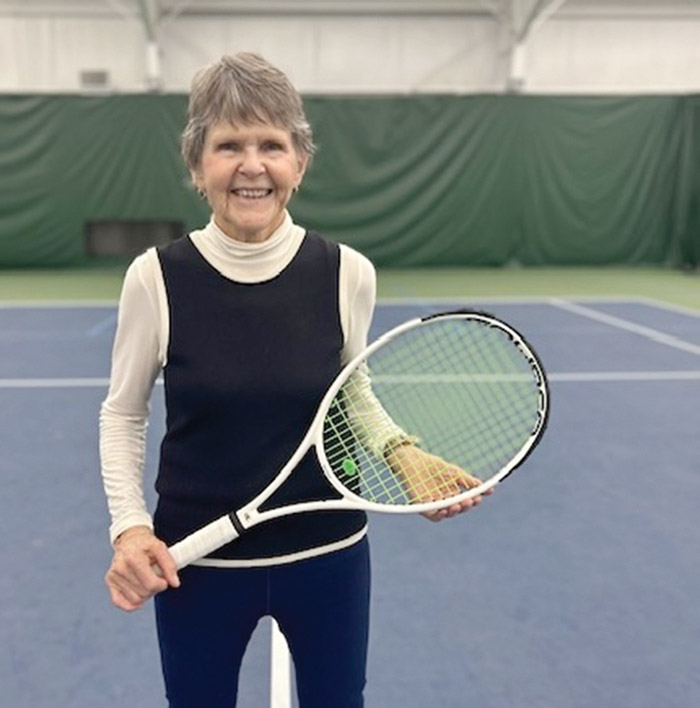
I am fortunate and grateful to be a member of Indian Creek and have access to an indoor court. This is why I am still able to play tennis at almost 82. And in this community we are fortunate to have an outstanding tennis professional, George Christoforatos. He is to be lauded for his effort to start tennis teams at local schools when they have no courts.
I have not given up hope that someday public tennis courts will become a reality here.
Writer, editor, instructor, Gail Wilson Kenna is the author of several books, including her memoir, Tennis Talk of a Nobody, published in 2023.