by Kathy Reshetiloff,
Chesapeake Bay Journal
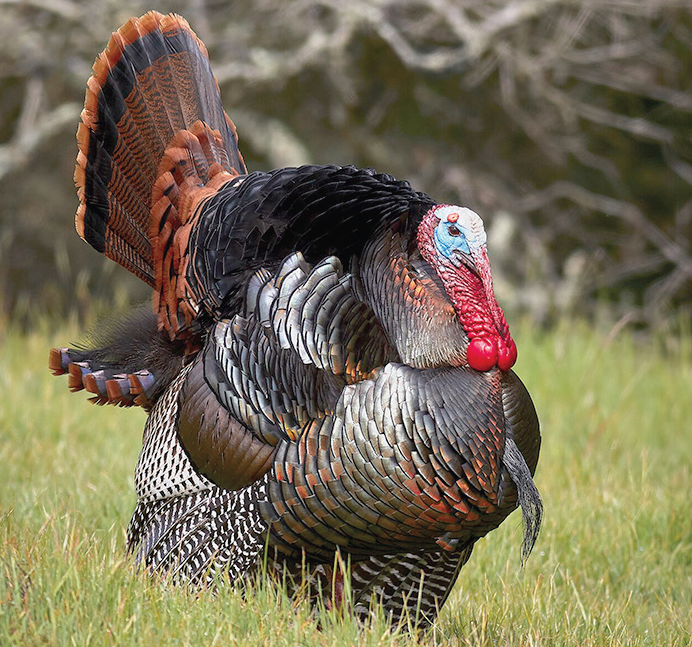
Before there were poultry farms, Americans hunted wild turkeys. In November, as we prepare for Thanksgiving dinners with friends and family, we’re reminded of this native game bird, found from southern Canada throughout the 48 contiguous states and Hawaii—and even in central Mexico and along the Sierra Madre Occidental mountain range. That’s a heartening recovery for a bird that was nearly wiped out by the 20th century.
The common name “turkey” may be attributed to the fact that the birds were transported to England through Turkey—first called “turkey coq” (meaning turkey rooster) and then shortened to just turkey. The wild turkey (Meleagris gallopavo) is a large bird, 36 to 44 inches in length. Known for their large, fan-shaped tails, wild turkeys have long, pink or gray legs; short, rounded wings; and bare heads and necks. They are covered with iridescent bronze feathers with black and white wing bars. In the East, the tips of their tails are brown; in the West, they’re white.
The male of the species has a tuft of feathers called a beard on his chest, as well as an upwardly curving spur on the back of each of his lower legs. His breast feathers have black tips, and he has a bluish-gray neck. He also has a red fleshy lobe of skin that hangs from the neck and chin, known as a wattle. The male’s bare head and neck are red, blue or white, depending on the season…..