by AnnGardner Eubank
Most high schoolers spend their summer breaks working a seasonal job and putting schoolwork on hold, but Northumberland High School senior Tawny Bowis found a way to turn her shifts on a Chesapeake Bay ferry into groundbreaking marine research. That summer hustle recently landed her at the Virginia Sea Grant Leadership Conference, where she stood as the sole high school presenter among a number of graduate researchers.
Every two years, students, researchers, policymakers and industry leaders throughout the Commonwealth convene to showcase research and expand professional networking channels regarding Virginia’s coastal future.
The university-based partnership program is one of 33 programs nationwide within the National Oceanic and Atmospheric Administration Sea Grant College Program. The event, which highlights cutting-edge research findings, is predominantly comprised of graduate students. Out of the 30 poster presenters at the event, Bowis was the only high school student.
Growing up in Reedville with deep family roots on Tangier Island, Bowis has always been surrounded by the water. However, her passion for marine research was truly piqued during her sophomore year when she took her first aquaculture class. “I just fell in love with it,” she said.
While many students typically look forward to pushing academics to the wayside when summer break rolls around, Bowis took full advantage of her circumstances and conducted an independent study, advised by the Virginia Institute of Marine Science. (VIMS)
When Bowis initially reached out for guidance regarding her independent study, VIMS provided a couple of topics to consider. She ultimately landed on determining a baseline for microplastic pollution on Tangier.
“I’m very connected with Tangier,” Bowis said.
With a number of cousins and her grandmother hailing from Tangier and calling the Island “home,” Bowis’s connection helped drive her work.
In the summer, Bowis crews on her family’s ferry boat, Chesapeake Breeze. Utilizing her time docked on the island, Bowis was able to conduct the first half of her research before school was back in session.
She began collecting samples in July. Her aquaculture teacher, Gary Dickens, joined her the first day to help show her how to properly collect the samples. From then on, once the cruise was docked and visitors were exploring the island, Bowis and crew mates would make their way to various points of the island to collect samples. They collected about five samples a day on average, she said.
Maintaining the spirit of summer, they made sure to get some ice cream most days after collecting their samples.
The samples were kept in a fridge at the high school. Once school was back in session, she and her aquaculture class worked together to analyze the data, she said.
“It was a class effort, we were going through the mud together,” she said.
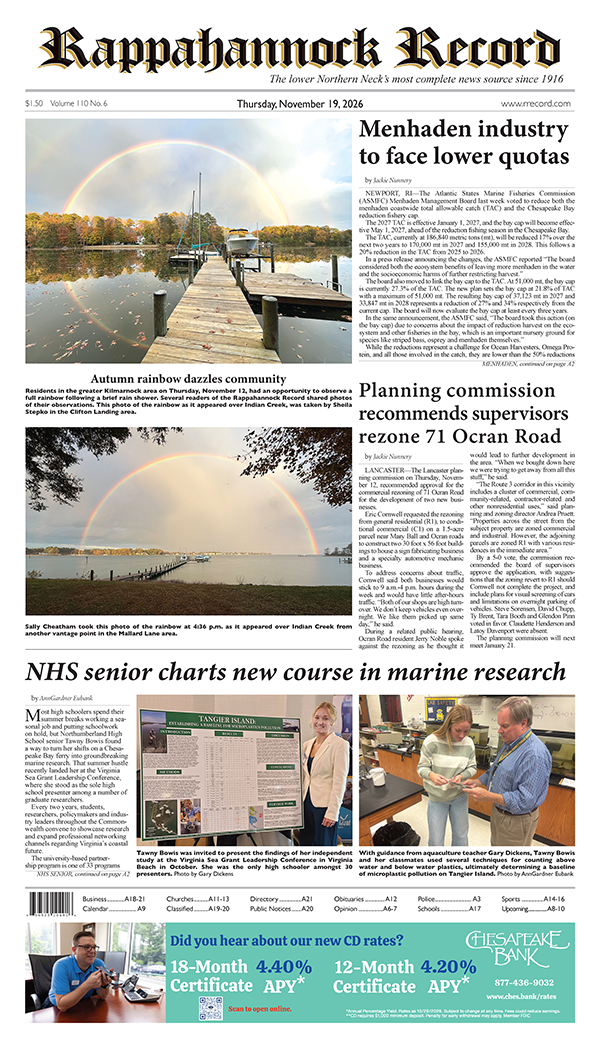
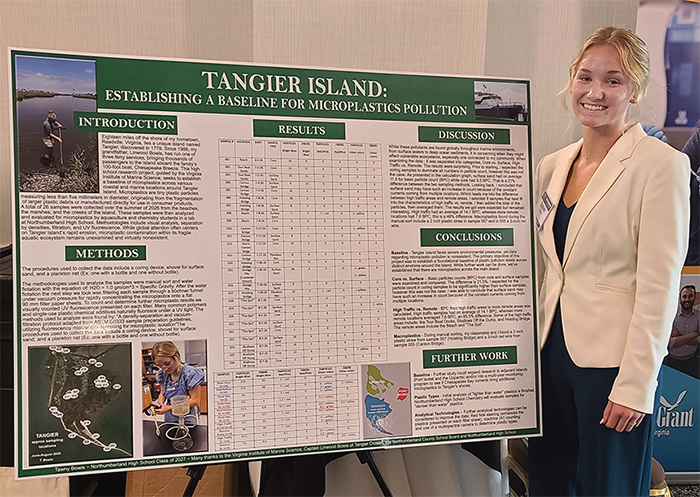
After the classroom analysis was complete, Bowis was invited by Virginia Sea Grant to present the findings for her project, “Tangier Island: Establishing a Baseline for Microplastics Pollution” at the Virginia Sea Grant Leadership Conference.
Bowis said she collected 26 samples over the summer from beaches, marshes and creeks of the island. Those samples were later analyzed and evaluated by her and the aquaculture class. She used a corning device, a shovel for surface sand and a plankton net to collect her data.
Bowis led the class research by filtering each sample under vacuum pressure to concentrate the microplastics onto filter paper. The class then visually counted UV fluorescence on each filter to determine the microplastics within the samples.
She was a bit surprised by her findings, said Bowis. When she first set out on her research, she thought the largest amount of microplastics would be found deeper within sediments, but was shocked to find a large amount actually sitting on the surface.
Tangier faces a lot of strong currents along its shores and she believes pollution from other locations is what drives the amount of microplastics on the surface, she said.
Bowis found that surface sand had an average 11.5 basic particle count (BPC) with core samples at 9.5 BPC. High traffic areas had an average of 14.1 BPC, compared to remote locations at 7.6 BPC.
This was the first research of its kind for Tangier Island. Bowis’s findings established a foundational baseline of plastic pollution levels across different areas of the island.
While Bowis led the research, she was supported by Dickens and classmates.
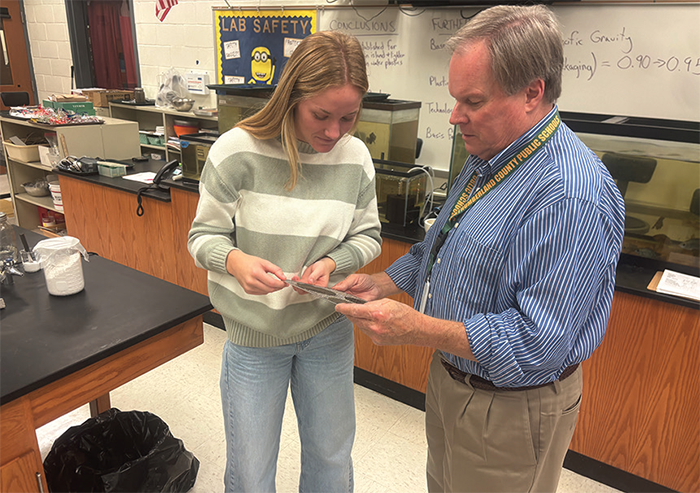
According to Dickens, NHS is the only public high school in the state that offers aquaculture and aquaculture II courses. The main curriculum is derived from Virginia Tech, he said. The class meets twice a week and operates through hands-on learning.
The class of eight students spends much of its class period completing chores. This includes taking care of oysters by feeding them and making sure ammonia and other chemical levels are right, monitoring eel grass ranks and testing guppy tanks.
“Eel grass is a foundation species in the bay. It’s not easy to raise,” Dickens said.
The class received its eel grass from VIMS to raise. It needs a cool period to germinate. One of the class’s chores includes monitoring the temperature and keeping it cool.
Focusing on fin fish in the first half of the year and shellfish in the second, students also learn through various labs and other research projects.
The class plans to go on its first overnight trip in December to the Eastern Shore to learn about bay scallop restoration.
Bay scallops were nearly deemed extinct in the Chesapeake, but the species was found in North Carolina. Utilizing eel grass, researchers believe they can bring a bay scallop population back to the Chesapeake, Dickens said.
Bowis said she hopes over time more and more people, particularly the younger generations, realize how everyone is connected by water and the importance of stewarding a healthy ecosystem.
The aquaculture course also has helped shape Bowis’s career goals.
“I want to come back to my community and help improve it somehow,” she said.
Growing up in a rural, coastal community like Northumberland, she sees first hand just how important it is to protect the waterways, she said.
When she graduates in the spring, she wants to further her education through marine studies. Her dream is to go to William & Mary, said Bowis.
Beyond the lab, she is a force to be reckoned with in all aspects of her life. Bowis is the captain of the volleyball team, serves as student council president, vice president for BETA Club, vice president of the Fellowship of Christian Athletes, captain of the Indian Spirit Dance Team, competes on the swim and softball teams, is a part of Mu Alpha Theta Math Honor Society, and helps run school pep rallies as the unofficial “emcee.”
For Tawny Bowis, the world truly is her oyster, and she is just getting started.