When late summer rolls around in the Northern Neck, it is time for the school year to begin. But back in the late 1800s a different tradition began taking place which brought thousands of people to the area. Camp meeting days as they were called, became the highlight of everyone’s calendar nearly every year.
Every July or August for a week to 10 days, thousands of people gathered at three different camps—Wharton Grove in Lancaster County, Kirkland Grove in Northumberland County and Marvin Grove in Richmond County—for days of prayer and sermons, and evenings of singing, fellowship and community.
Changing times made camp meetings a thing of the past, but the groves still hold fond memories for those who attended.
Kirkland Grove
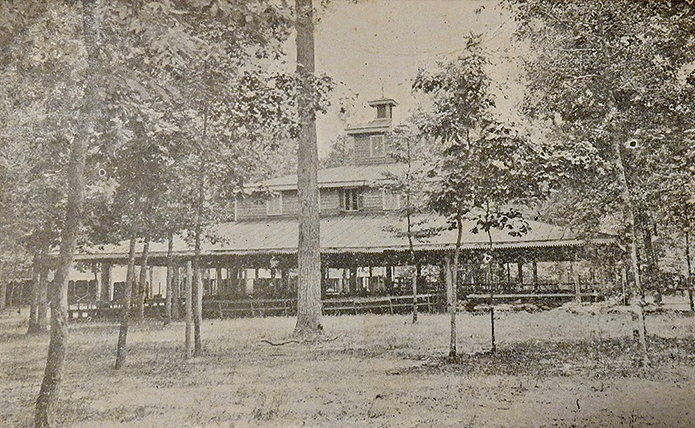
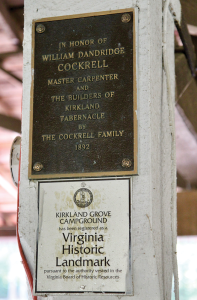
Little did anyone know that actions taken in 1892 would have reverberations felt today. Back then, James Booth conveyed 23.5 acres of land outside of Heathsville to the Kirkland Grove Baptist Camp-Meeting Committee, named in honor of Dr. William Heath Kirk, a Baptist minister active in Northumberland County from 1845-1884. While the week-long revivals no longer take place, Kirkland Grove has the distinction of having the last standing tabernacle of the Northern Neck groves. It also is one of the few remaining 19th-century religious campgrounds in the state. The site was placed on the Virginia Landmark Register in 1991 and the National Register of Historic Places (NRHP) in 1992.
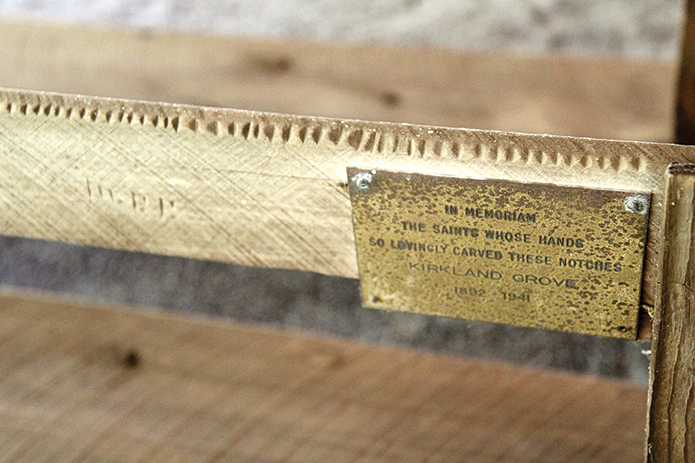
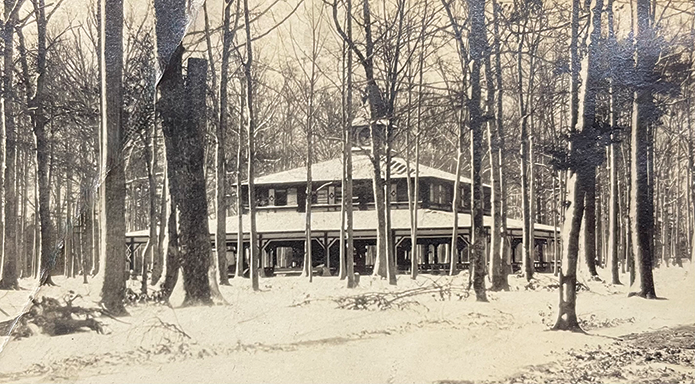
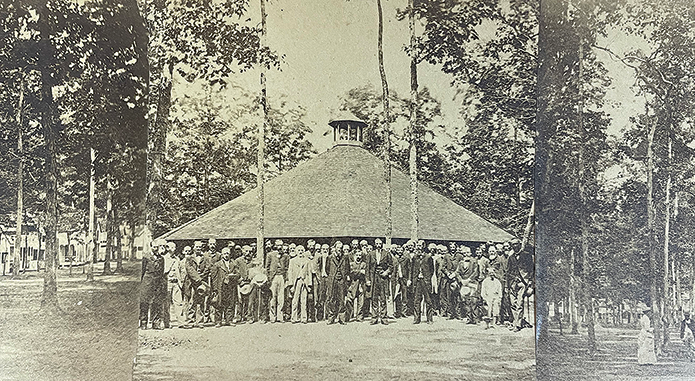
The 90-foot, square tabernacle, according to the NRHP application, was constructed by William Dandridge Cockrell and his brother John with timber milled from trees on the property, and by some accounts, designed to biblical specifications. Under the four-tiered tin roof, the design remains beautifully simple—daylight and ventilation coming from above through shuttered windows in the second-tier, bare lighting fixtures strung on exposed rafters and seating for about 1,000 people provided by 100 18-foot long wooden benches worn from the comings and goings of generations of worshippers.
A still-working bell is at the top, ready to call campers for services. Once seated, they all faced an elevated speaker platform with additional space for a choir or band at the center of the tabernacle.
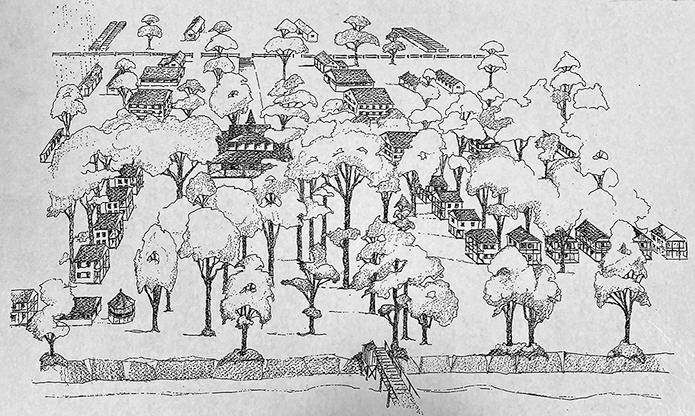
Long gone are the 42 rustic two-story cottages that generations of Northern Neck families stayed in while gathering every August. Others stayed in one of two hotels on the grounds. Written accounts gathered on Kirkland’s 100th anniversary recall concession stands selling ice cream, lemonade, candy and other treats. There also was a barbershop, bootblack stand and a photographer taking and selling pictures for the occasion.
Like the other camps, the meetings were a mixture of sermons, Bible study, gospel music, socializing, and for some, that included courting. Many couples met and later married as a result of their meeting at Kirkland Grove.
“All ages promenaded on the dusty grounds between the services. An area known as the bullpen was designated to keep those who continued to promenade” from disturbing those in the tabernacle during services. “Many ladies took this opportunity to show off their new clothes while others enjoyed just sitting on the porches and visiting with their friends,” as noted in the Kirkland Grove Campground 100th anniversary program, 1992.
Popularity of the revival camps waned in the 1930s and Kirkland closed in 1941. Over the next few decades, efforts were made to revive the revivals, some more successful than others. By 1965 when the Rappahannock Baptist Association took over, most of the cottages were gone or in disrepair, but improvements were made to bring electricity, phone and running water to the remaining buildings.
While week-long revivals no longer take place, the grove is still in use. In 1976 the bicentennial was recognized there and included a reenactment of the original service at Kirkland Grove. Scouts BSA Troop 250 meets and camps on the grounds and Scouts Trystan Campbell and Michael Brown made improvements to the property as part of their Eagle Scout project. The Callao Volunteer Fire Department and Northumberland County Sheriff’s Office have both used the property for training and last year, Revive the Spirit, a gospel concert fundraiser for the campground was held. The property also is available for groups to rent.
Wharton Grove
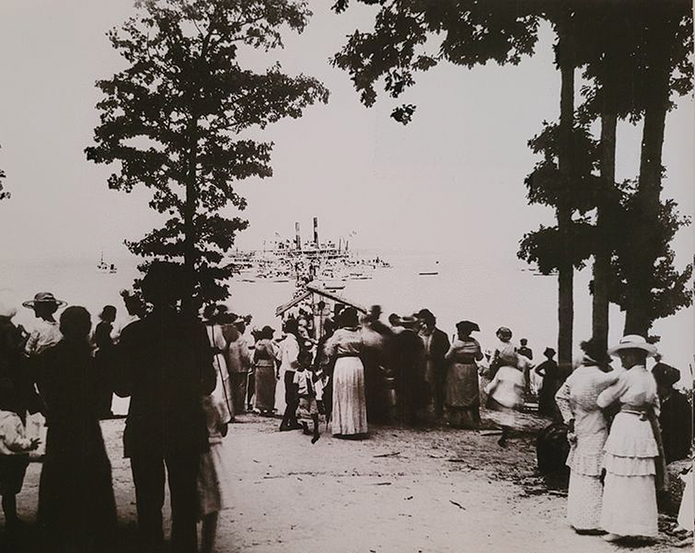
It all began with an idea from John Palmer to hold interdenominational meetings during the height of religious revivals. In a history included in Virginia’s Northern Neck: A Pictorial History by John C. Wilson, he wrote that Palmer, then an agent selling part of the old Robert “King” Carter estate, convinced Baptist Rev. F.W. Claybrook to establish a religious meeting camp on the site. Claybrook then enlisted Dr. H.M. Wharton a Baptist evangelist, and from 1893 to 1927, thousands would flock to the camp on the Corrotoman River for 10 days nearly every summer, with many coming from out-of-town by steamboat or boat.
It was said as many as 10,000 people would arrive for the final Sunday of the revival. “Wharton Grove led in popularity because it was the only one directly on a broad river highway and thus easily reached from scores of communities,” John Wharton, son of the camp’s namesake wrote in Wharton Grove Camp Days, one of his many essays about his years spent at the camp.
An 1896 account in the Virginia Citizen reported “the little bay was fairly alive with a fleet of sails and steamers” and canoes ran a ferry service from Millenbeck. The tabernacle was full to overflowing, with hundreds standing outside or on the waterfront. In 1904, the paper referred to “unprecedented” crowds that continued to arrive at the “famous” camp.
The 40-acre camp was rustic like Kirkland. No electricity, no running water, just surface wells that often ran muddy. “The buildings provided the roughest sort of accommodations,” Wharton wrote in an essay, The Famous Wharton Grove Camp Meetings. “Why not, with use limited to 10 days a year?” While rustic, the cottages typically had gingerbread trim which was popular at that time.The rustic nature applied to some furnishings like beds—“a nailed-in wall bunk with straw-stuffed ticking”—which led to some bringing cots or hammocks for more comfort. “Every cottage had to have a porch from which to view the passing parade and spend the hours chatting except during tabernacle meeting hours,” he wrote.
“Almost everything about the 10 days of camp meetings was inconvenient, even crude, compared to other Chesapeake summer vacation spots. But who minded? Not any of the thousands—up to 10 or so— who never missed a meeting. It was carnival time laced with sermons, hymns and good old-time gospel fellowship,” wrote John Wharton, in The Seventeen Wharves of Wharton Grove.
Also much like Kirkland Grove, at the center of the 43 cottages stood the three-tiered tabernacle, 90 feet square with seating for 2,000 people. At its top was a steeple and bell which called worshippers to the meetings. Completing this temporary village were “two large hotels for transients, two large dining rooms—really open sheds—two confectioneries and utility buildings.” There was even a barbershop and dentist’s office, Wharton said.
The camp’s popularity went into decline with the death of Claybrook in 1914 and the beginning of World War I, leading to its closure. However, Dr. Wharton was able to reopen it in 1920 with improvements. The camp was electrified through its own power plant; running water was available through a new artesian well; a new wharf was built and cottages were repaired. The rebirth was short lived, the last camp was held in 1927 and H.M. Wharton died in June 1928. His son said Dr. Wharton had “engaged all participators for the ensuing season and everything had to be suddenly cancelled.”
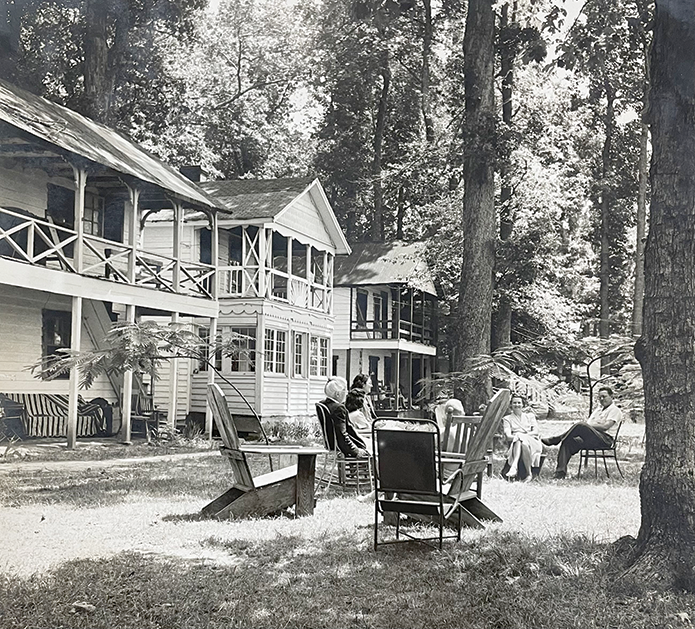
During the 1930s, the Wharton family reopened the property as a summer vacation resort. Over time, it too closed and much of the remaining camp structures disappeared. The remnants of Wharton Grove were last inventoried by the Virginia Department of Historic Resources in 1997. At that time they noted 12 buildings, nine of which were deemed historic with construction dated to 1893. The two-story Queen Anne architecture “with porches overlooking the river” and “scalloped trim work,” were said to be a “combination of imitation, personal taste and practicality.”
There were eight cottages remaining in addition to a 1950 log structure. “In 1950 three cottages—Kirk, Willey and Wharton— were joined as one by architect Walter M. Macomber.” The report also noted that alterations were made to other cottages—enclosing porches, adding chimneys, side porches, windows and detailing. All that remained of the tabernacle, the center of the camp, were the footings. The property is now privately held.
Marvin Grove
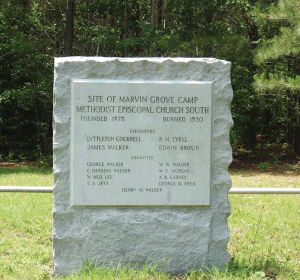
In Farnham, all that remains of Marvin Grove is a granite marker. The Methodist camp was built in 1878, with its first 10-day revival taking place on Friday, August 2, with Bishop David S. Doggett of Lancaster providing the sermon. Along with a tabernacle, there were two 50-room hotels that were booked weeks in advance, such was the popularity of the summer event.
John Efford recalled traveling to the grove in late July to get the cottage ready for the August revival by “re-whitewashing the exterior” and since the cottage “was without doors or window sash,” they had to sweep out the leaves. His story, “Camp Meeting Days,” was included in a Richmond County bicentennial book. As a boy he “vividly” remembered the “bell on the tabernacle ringing for the services and meals and although I was put to bed early, I would lie and listen to the singing and fall asleep.”
According to a 1935 article by George Reed in the Richmond Christian Advocate, the first years of the camp were self sustaining. “The amount received from ground rents, concessions for hotels, stores, horse lots, etc., together with the Sunday collections” covered operating expenses, upkeep and some improvements over the years. With automobiles, “everything was changed. While greater numbers attended the encampment afternoons and evenings, many tents were unoccupied and few spent the week.”
Then in the summer of 1930 Marvin Grove caught fire. “The beautiful trees, the tabernacle and about 60 cottages were soon consumed.” Talk of rebuilding gave way to the reality that “to rebuild Marvin Grove Camp would have been more of an undertaking than conditions would justify,” Reed wrote.
Reed also spoke at the installment of the granite marker at the Marvin Grove site in 1938. “The memory of this sacred spot will ever linger in the hearts and minds of those who loved and cherished old Marvin Grove.” This marker represented “the memory of what Marvin Grove stood for” and the hope that “the memory of what Marvin Grove stood for will be passed on through the generations to come.”
“When’er the week had ended, we moved back home again,
Revitalized and happy that we’d reaped some ‘golden grain.’
A seed of love, a seed of faith, a seed of friendship too,
We found in our possession, with others that we grew.
“What a week that used to be! Too bad that it’s now lost.
It’s true, there’s been much progress, but was it worth the cost?
On early August mornings, when air is cool and damp,
A ‘wagonload’ of memories goes back to Kirkland Camp.”
—From the poem Camping at Kirkland by G.M. Burroughs
 This is just one of the great articles in our most recent print supplement, Bay Heritage 2026, included with the September 24 edition of the Rappahannock Record.
This year’s features include Unearthing History at Old Saint John’s, Farming Through the Generations, Steamboat Commerce on the Water and a pictorial history, Down on the Farm.
It is available to read FREE as a pdf: https://rrecord.com/wp…/uploads/2026/09/RSSUP092426.pdf
or inside our e-Edition for subscribers: https://rappahannockrecord-va.newsmemory.com.
Click here for our full gallery of local print supplements: https://rrecord.com/supplements.